
Neighbourhood guide · Toronto & the GTA
Living in Orangeville: Neighbourhood & Real Estate Guide
Moving to Orangeville? Neighbourhoods, 2026 home prices, commuting, schools and honest pros and cons from Realtor Irina Marchenkova.
By Irina Marchenkova, Sales Representative, RE/MAX Realtron Realty · Senior Real Estate Specialist (SRES®) · Last updated September 2026
Orangeville is the main town of Dufferin County, northwest of Brampton and Caledon, at the edge of the Hockley Valley and Headwaters countryside. It combines a historic downtown on Broadway, a local hospital and newer family subdivisions, at prices well below Peel Region. Here’s what to know before you buy or sell in Orangeville.
Neighbourhoods Prices Market Costs Transit Schools Checklist FAQ
Orangeville at a glance
- Where: Dufferin County, northwest of Caledon and Brampton, at the junction of Highways 9 and 10
- Population: about 30,000 (2021 Census: 30,167)
- Typical home price: $707,400 MLS® HPI benchmark for all home types (August 2026)
- Getting to Toronto: by car via Highway 10 and 410, usually an hour or more; there’s no GO train
- Best for: families wanting a complete small town with a hospital, at lower prices than Peel
Why people choose Orangeville
- A complete town: a hospital, recreation centres, big-box and downtown shopping
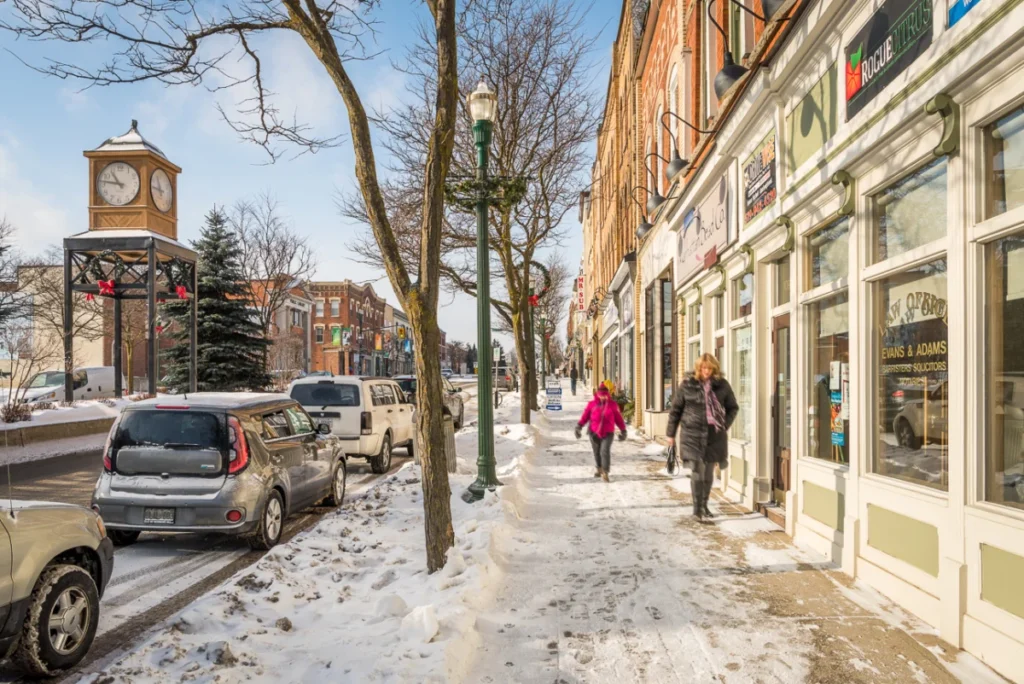
- Historic downtown: Broadway’s shops, restaurants and Theatre Orangeville
- Countryside: Island Lake Conservation Area, the Hockley Valley and Mono Cliffs Provincial Park nearby
- Value: detached homes far below Peel Region and Toronto prices
Orangeville works well for families who can commute a few days a week, or who work locally or in Brampton. You get a complete town with its own hospital at a much lower price. — Irina
Orangeville neighbourhoods
Here’s how Orangeville’s main areas differ:
Downtown and Broadway
Older homes and heritage buildings near Broadway’s shops, restaurants and the theatre.
Established neighbourhoods
Family homes from the 1970s to 1990s with mature trees, close to schools and parks.
Newer subdivisions
Detached homes, semis and townhouses on the town’s edges, especially to the south and west.
Nearby countryside
Rural and estate properties in neighbouring Mono and Amaranth, often with wells and septic systems.
Homes and prices in Orangeville
Mostly detached homes, with semis, townhouses and some condo apartments.
Orangeville benchmark prices (August 2026)
Here’s how Orangeville compares with the whole TRREB area and the City of Toronto:
| Area | All homes | Detached | Semi-detached | Townhouse | Condo apt. |
|---|---|---|---|---|---|
| Orangeville | $707,400 | $860,000 | $652,500 | $492,400 | $371,500 |
| All TRREB (GTA) | $925,900 | $1,209,600 | $919,000 | $666,500 | $531,200 |
| City of Toronto | $918,400 | $1,437,900 | $1,127,200 | $717,200 | $547,400 |
A typical detached home in Orangeville was benchmarked about $577,900 below the City of Toronto figure in August 2026. The composite benchmark was down 3.28% year over year, while the detached benchmark was up 0.37%. Ask me for recent sold prices on any street.
Thinking of selling? Get a free home evaluation and I’ll show you what comparable homes near you have actually sold for.
Market snapshot
Here’s how many homes sold and at what prices in August 2026, for all home types combined:
| Area | Homes sold | Average price | Median price |
|---|---|---|---|
| Orangeville | 28 | $755,759 | $755,378 |
| All TRREB (GTA) | 5,057 | $993,410 | $850,000 |
Across the whole GTA in August 2026, homes sold for about 97% of their final list price on average and spent an average of 35 days on the market. GTA sales were down 2.1% from a year earlier and the average price was down 2.7%, so buyers have more choice and negotiating room than in recent years. Monthly numbers for a single town can swing a lot, so ask me for a free market report on a specific street.
What it costs to buy in Orangeville
Land transfer tax
Orangeville is outside the City of Toronto, so buyers pay only Ontario’s land transfer tax, not the extra Toronto municipal tax. Here’s what that looks like at typical prices:
| Example purchase | Ontario LTT | First-time buyer pays |
|---|---|---|
| Detached home at $860,000 | $13,675 | $9,675 |
| Townhouse at $490,000 | $6,275 | $2,275 |
First-time buyers can get a refund of up to $4,000 on the Ontario land transfer tax. You (and your spouse) must never have owned a home anywhere in the world. Land transfer tax is paid on closing, on top of your down payment. Try the land transfer tax calculator.
Property taxes
Property tax in Orangeville is your home’s MPAC assessed value multiplied by the combined residential rate (local, upper-tier and education). Check the Town of Orangeville website for the current year’s rate, and ask the seller for the latest tax bill. MPAC values are still based on January 1, 2016 and are usually well below today’s market price.
Getting around
- Driving: Highway 10 connects south to Highway 410 and Brampton; Highway 9 runs east to Highway 400. Toronto is usually an hour or more by car.
- Transit: Orangeville Transit runs local buses, and GO buses connect to Brampton. There’s no GO train.
- Car needed: most households rely on a car.
Schools and family life
Orangeville is served by the Upper Grand District School Board and Dufferin-Peel Catholic District School Board, with French-language options through Viamonde and MonAvenir. Always check each board’s school locator for a specific address.
Headwaters Health Care Centre is Orangeville’s hospital.
Child care
At licensed centres enrolled in the Canada-wide Early Learning and Child Care program, fees for children under 6 are capped at $22 a day in 2026, and families with lower incomes can apply for a fee subsidy. Dufferin County’s children’s services team lists licensed child care and EarlyON centres, including those in the reduced-fee program. My tip: get on waitlists early and ask each centre whether it’s in the reduced-fee program.
Parks, shopping and things to do
- Downtown: Broadway’s restaurants, shops and Theatre Orangeville
- Outdoors: Island Lake Conservation Area, the Hockley Valley and Mono Cliffs Provincial Park
- Recreation: Alder Recreation Centre, arenas and trails
- Events: the Orangeville Farmers’ Market and seasonal festivals
Pros and cons of living in Orangeville
Pros
- Complete town with a hospital
- Detached homes far cheaper than Peel
- Historic downtown and theatre
- Countryside and conservation areas close by
Cons
- Long commute to Toronto; no GO train
- Most households need a car
- Highway 10 traffic
- Fewer local high-paying jobs
Before you buy in Orangeville: local checklist
Every area has its own rules and quirks. Here’s what I check with buyers in Orangeville:
- Conservation areas: properties near creeks and wetlands may be regulated by Credit Valley Conservation or Nottawasaga Valley Conservation Authority.
- Wells and septic: for rural properties, arrange water testing and a septic inspection as conditions of your offer.
- Commute test: try the drive to your workplace at rush hour before you buy.
- New builds: review the Tarion warranty, closing adjustments and any development charges not capped in your agreement.
- Condos: always review the status certificate, reserve fund study and any upcoming special assessments before you firm up an offer.
- Non-Canadian buyers: check the current federal foreign-buyer rules and Ontario’s Non-Resident Speculation Tax before making an offer.
Buying or selling in Orangeville with Irina
I’m a RE/MAX Realtron Realty Sales Representative and Senior Real Estate Specialist (SRES®), based in Scarborough and working across Toronto and the GTA. Whether you’re buying your first home, moving up or downsizing from a family home, I’ll help you compare neighbourhoods, price your home correctly and negotiate the best terms. I work in English and Russian.
Orangeville real estate FAQ
Is Orangeville a good place to live?
For families who want a complete small town with a hospital, schools and shopping at lower prices than Peel Region, it often is. The main trade-off is a long commute to Toronto.
How much does a house cost in Orangeville?
In August 2026, the MLS® HPI benchmark for all home types in Orangeville was $707,400, and for a detached home $860,000. The average sale price was $755,759.
Does Orangeville have a GO train?
No. GO buses connect Orangeville to Brampton, and most commuters drive via Highway 10.
How far is Orangeville from Toronto?
Usually an hour or more by car, depending on traffic and your destination.
What county is Orangeville in?
Dufferin County. TRREB reports Orangeville’s prices as part of Dufferin County.
Useful links
- Town of Orangeville
- Dufferin County
- Upper Grand District School Board
- TRREB Market Watch (monthly prices)
Nearby neighbourhood guides
Compare neighbourhoods: Most affordable areas · Best for families · Best for downsizing · First-time buyer guide · Downsizing guide · All neighbourhood guides